

1. Cấu tạo và nguyên lý hoạt động
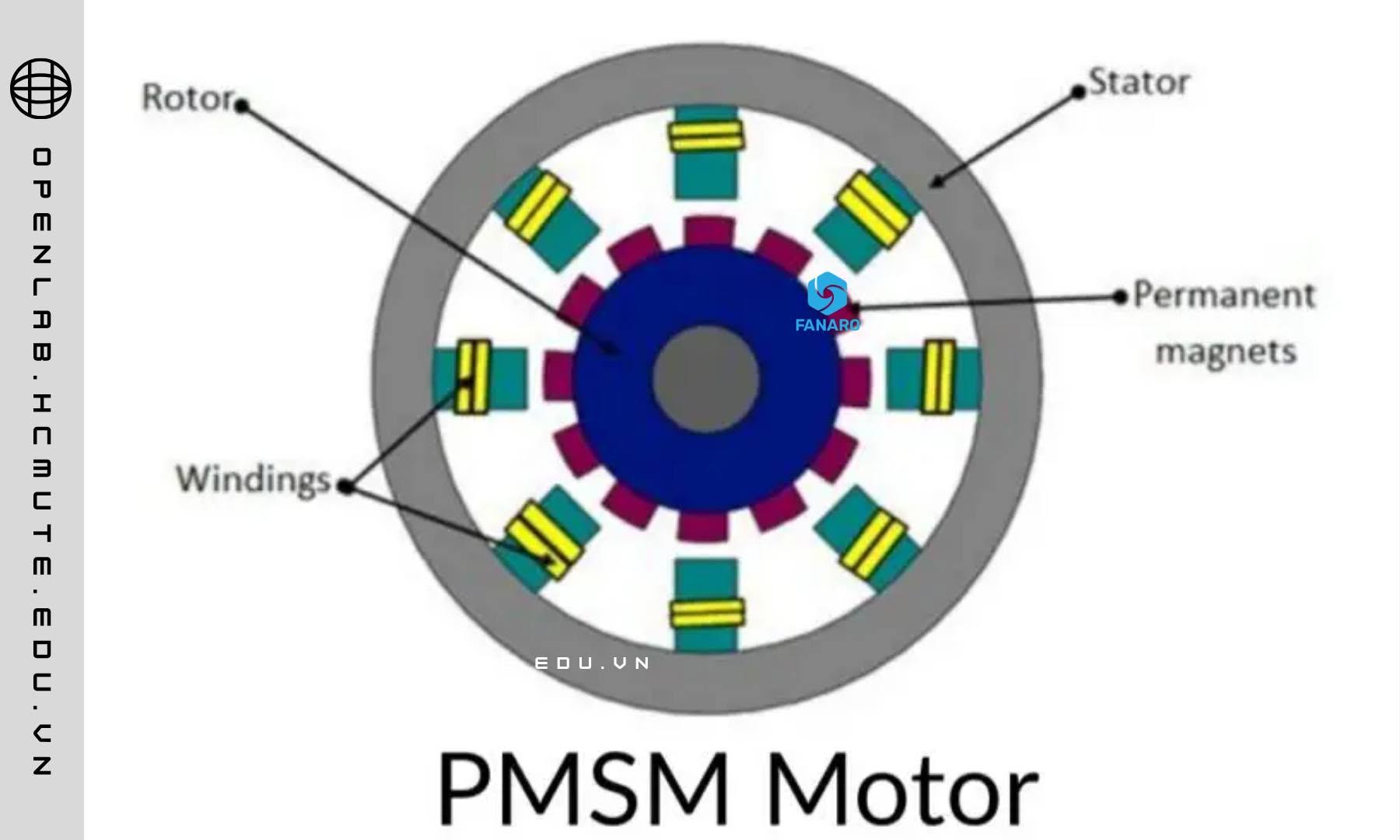
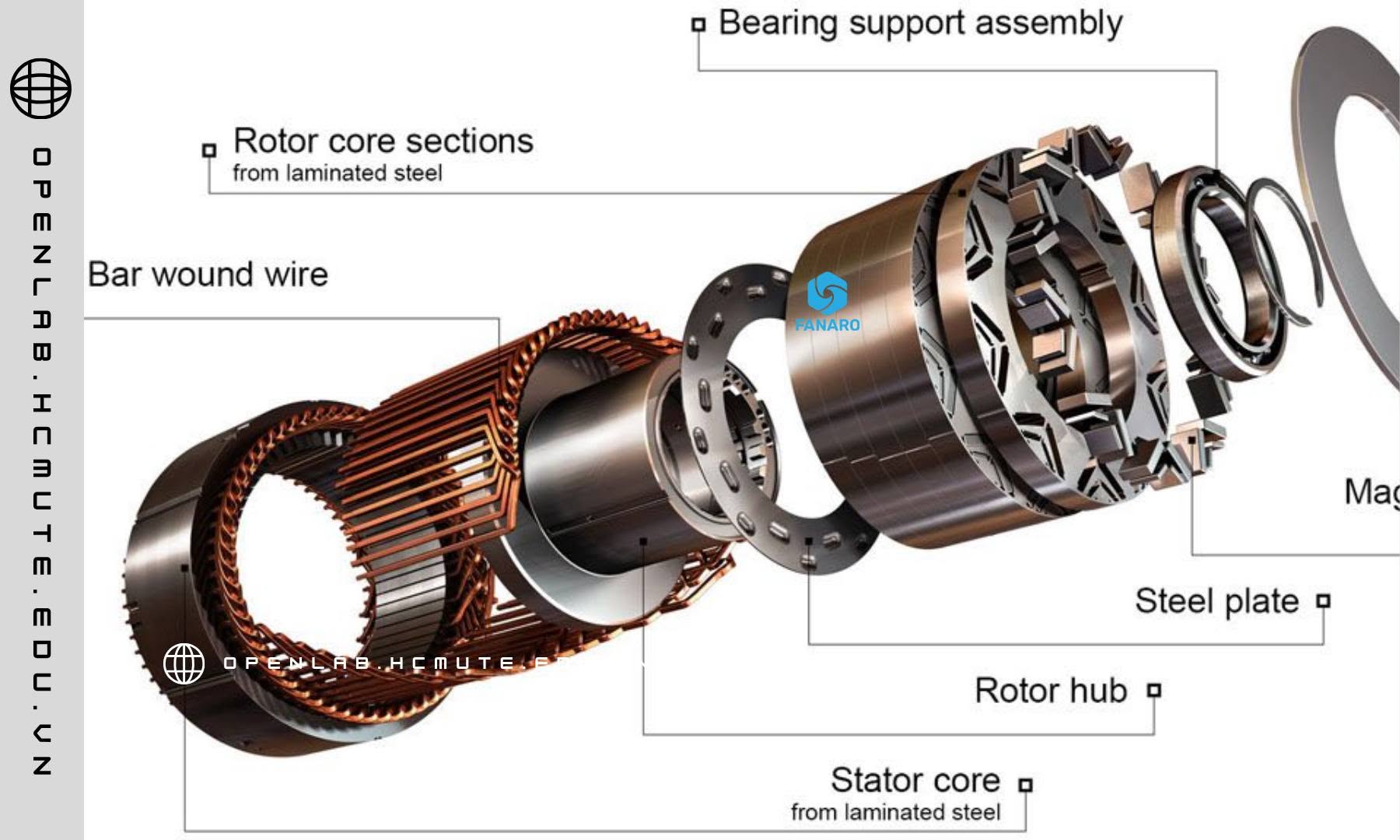
PMSM (Permanent Magnet Synchronous Motor – động cơ đồng bộ nam châm vĩnh cửu) là loại động cơ điện xoay chiều trong đó rotor được tích hợp nam châm vĩnh cửu (thường là hợp kim đất hiếm như Neodymium-Iron-Boron – NdFeB) thay vì cuộn dây cảm ứng như động cơ không đồng bộ (induction motor) truyền thống.
Về nguyên lý, khi dòng điện xoay chiều 3 pha được cấp vào cuộn dây stator, nó tạo ra một từ trường quay. Vì rotor đã sẵn có từ trường cố định từ nam châm vĩnh cửu, rotor sẽ “khóa pha” và quay đồng bộ hoàn toàn với từ trường quay của stator — đây chính là nguồn gốc tên gọi “đồng bộ” (synchronous), khác với động cơ không đồng bộ, nơi rotor luôn quay chậm hơn từ trường stator một độ trượt (slip) nhất định để sinh ra dòng cảm ứng.
Sự khác biệt tưởng chừng nhỏ này lại là gốc rễ của toàn bộ ưu thế kỹ thuật mà PMSM mang lại.
2. Vì sao loại bỏ được tổn hao trượt (slip loss)?
Ở động cơ không đồng bộ, cơ chế sinh mô-men xoắn phụ thuộc hoàn toàn vào độ trượt giữa tốc độ từ trường stator và tốc độ rotor. Độ trượt này tạo ra dòng điện cảm ứng trong rotor (theo định luật Faraday), nhưng đồng thời cũng là nguồn gây tổn hao nhiệt đáng kể (I²R loss trong rotor) — đặc biệt nghiêm trọng khi động cơ vận hành ở tải thấp hoặc tốc độ thấp, chính là điều kiện vận hành đặc trưng của quạt HVLS.
PMSM không cần dòng cảm ứng trong rotor để sinh từ trường — nam châm vĩnh cửu tự cung cấp từ trường không đổi. Kết quả là tổn hao đồng ở rotor gần như bằng 0, giúp hiệu suất động cơ (η) của PMSM thường đạt 90–96%, so với mức 75–85% phổ biến ở động cơ không đồng bộ cùng công suất.
3. Đặc tính hiệu suất tại dải tốc độ thấp — yếu tố quyết định với quạt HVLS
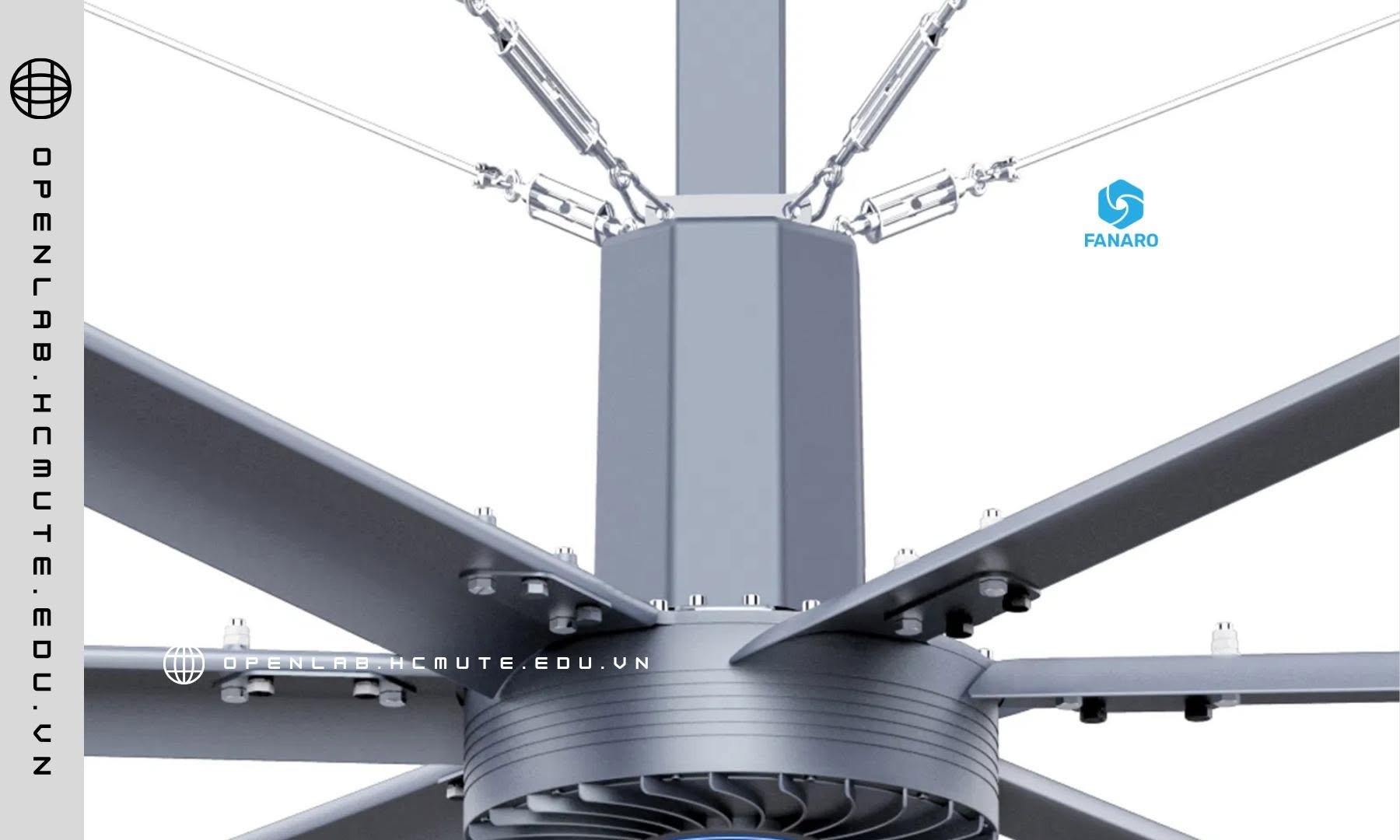
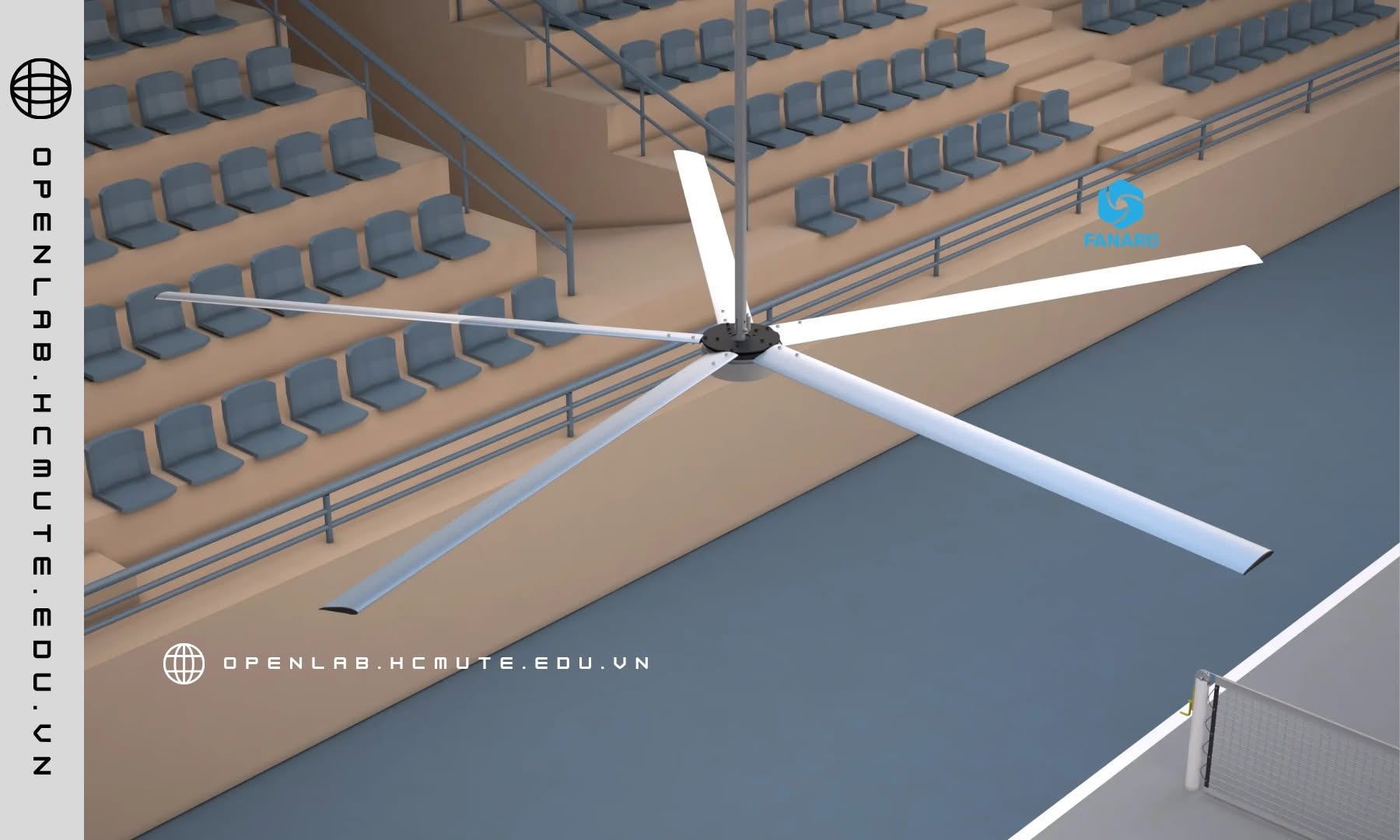
Đây là điểm kỹ thuật cốt lõi giải thích vì sao PMSM đặc biệt phù hợp với quạt trần công nghiệp HVLS. Quạt HVLS vận hành ở tốc độ quay rất thấp (thường 30–60 vòng/phút) nhưng cần mô-men xoắn đủ lớn để duy trì cánh quạt sải rộng (có thể lên tới 7 mét) chuyển động ổn định.
Động cơ không đồng bộ vận hành kém hiệu quả nhất chính ở dải tốc độ thấp — do tỷ lệ tổn hao trượt trên tổng công suất đầu ra tăng lên tương đối khi tốc độ giảm. Ngược lại, đường cong hiệu suất của PMSM tương đối phẳng trên toàn dải tốc độ, kể cả ở vùng tốc độ thấp — vì cơ chế sinh mô-men không phụ thuộc vào độ trượt. Đây là lý do kỹ thuật cốt lõi (chứ không chỉ là con số marketing) giải thích mức tiết kiệm điện năng 40–50% khi so sánh quạt HVLS dùng PMSM với hệ thống nhiều quạt công nghiệp nhỏ chạy động cơ không đồng bộ.
4. Truyền động trực tiếp (Direct Drive) — loại bỏ khâu trung gian cơ khí
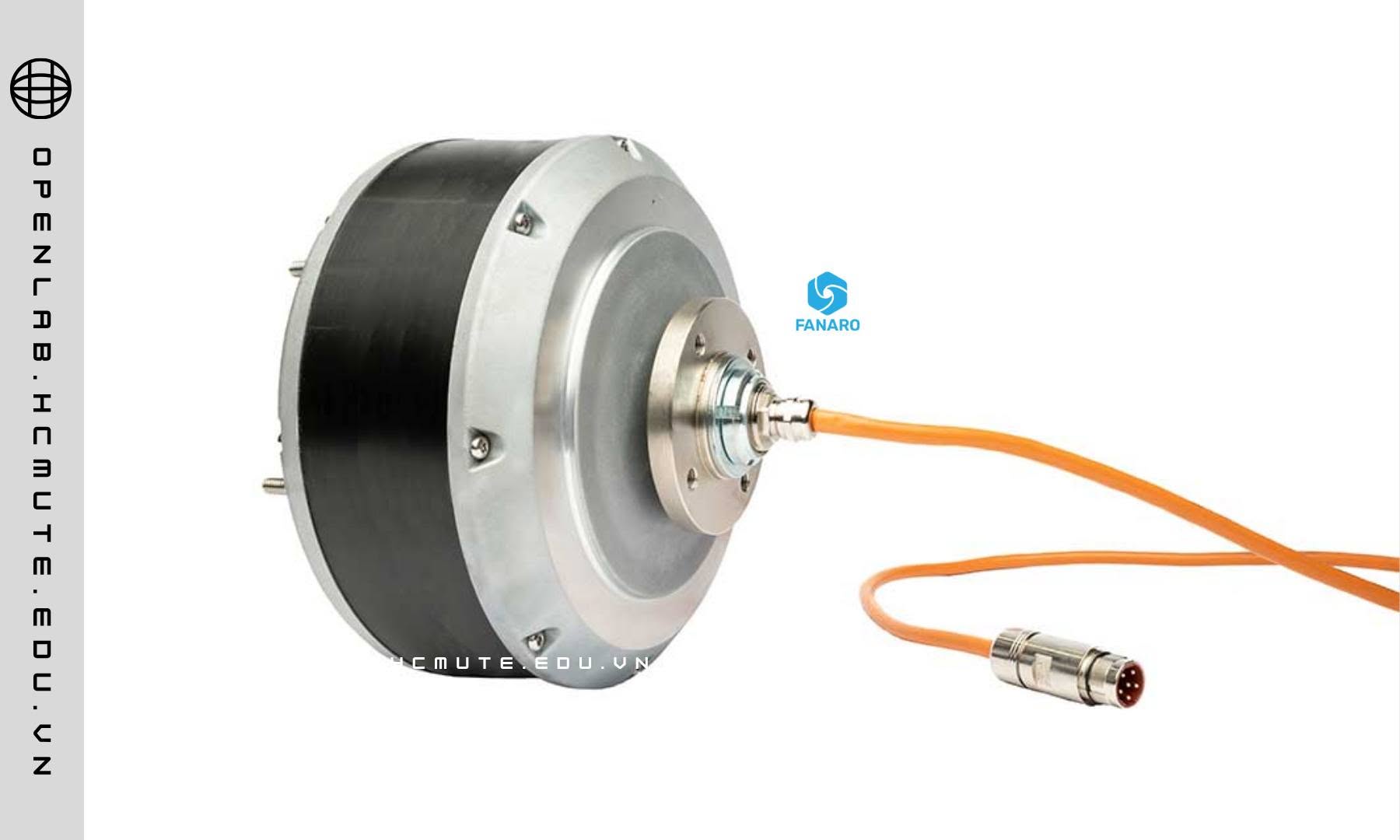
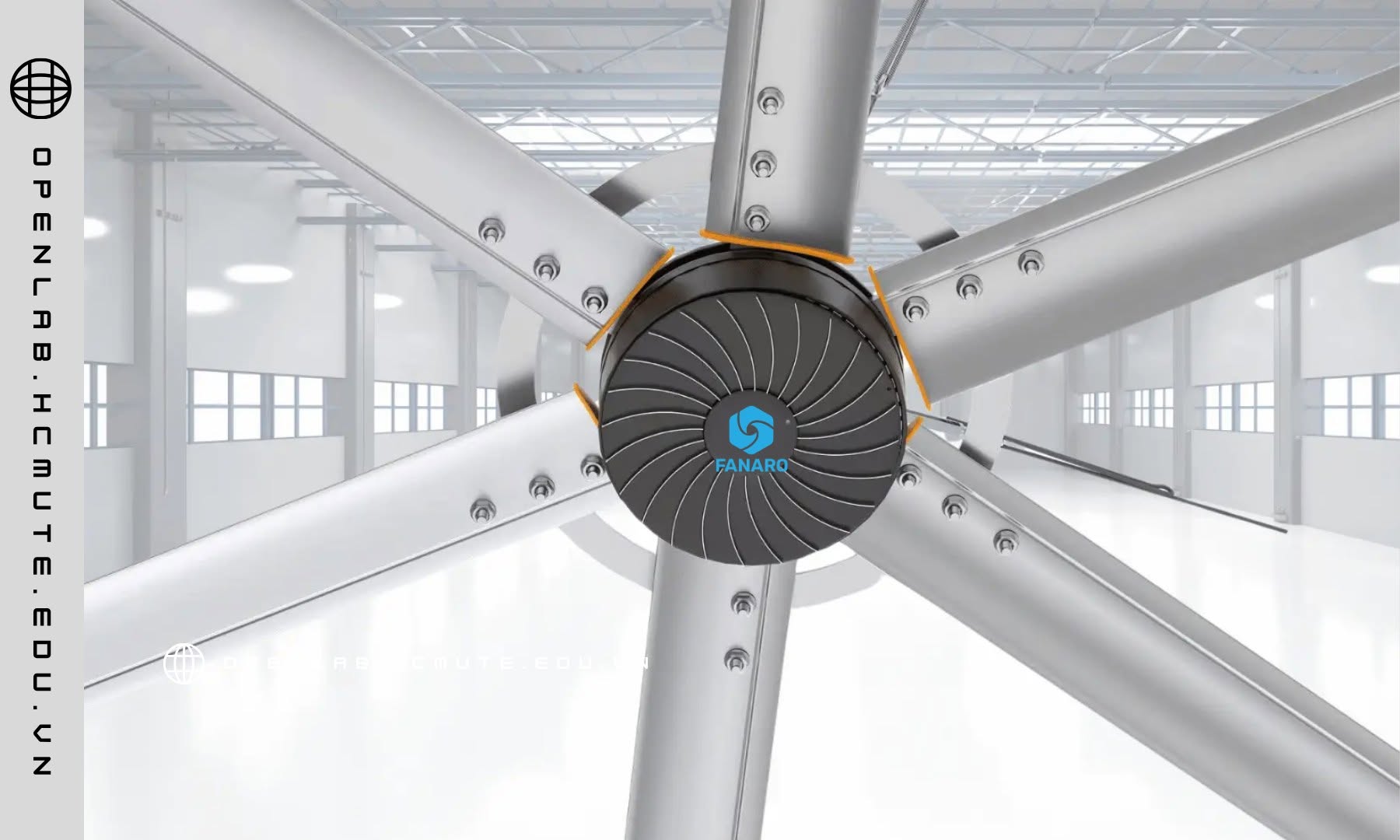
Nhờ đặc tính tạo mô-men xoắn cao ngay ở tốc độ thấp, PMSM cho phép thiết kế truyền động trực tiếp (direct drive) — trục động cơ nối thẳng với cánh quạt, không cần hộp giảm tốc (gearbox) hay dây curoa trung gian như nhiều hệ thống quạt công nghiệp cũ vốn dùng động cơ tốc độ cao rồi giảm tốc cơ khí.
Việc loại bỏ khâu trung gian này mang lại ba lợi ích kỹ thuật cộng hưởng:
- Giảm tổn hao cơ học: mỗi khâu truyền động trung gian (bánh răng, dây đai) đều gây tổn hao ma sát, làm giảm hiệu suất tổng thể của hệ thống
- Giảm điểm hỏng hóc: hộp số và dây curoa là hai bộ phận có tuổi thọ giới hạn, cần bảo trì định kỳ, tra dầu mỡ, thay thế theo chu kỳ — đây chính là nguồn gốc chi phí vận hành ẩn (hidden operating cost) mà nhiều doanh nghiệp không tính đến khi so sánh giá mua ban đầu
- Giảm tiếng ồn cơ học: không có tiếng ồn từ bánh răng ăn khớp hay ma sát dây curoa, chỉ còn tiếng ồn khí động học (aerodynamic noise) từ luồng gió — đây là lý do các dòng quạt PMSM đạt độ ồn dưới 40dB, gần với mức tiếng ồn của thư viện
5. Đặc tính nhiệt và độ bền động cơ
Vì không có tổn hao trượt trong rotor, PMSM sinh nhiệt ít hơn đáng kể so với động cơ không đồng bộ ở cùng điều kiện tải — nhiệt độ vận hành thấp hơn đồng nghĩa với việc vật liệu cách điện của cuộn dây stator, vòng bi (bearing) và các linh kiện điện tử đi kèm (driver, encoder) chịu ứng suất nhiệt thấp hơn trong suốt vòng đời sản phẩm. Theo nguyên lý Arrhenius áp dụng trong kỹ thuật điện (cứ tăng 10°C nhiệt độ vận hành, tuổi thọ cách điện giảm khoảng 50%), việc duy trì nhiệt độ vận hành thấp là yếu tố then chốt giúp PMSM đạt tuổi thọ vận hành dài hơn, giảm tần suất bảo trì và thay thế linh kiện.
6. Vai trò của bộ điều khiển (Driver/Controller)
Một điểm kỹ thuật thường bị bỏ qua: PMSM không thể vận hành trực tiếp từ nguồn điện lưới AC như động cơ không đồng bộ — nó bắt buộc phải đi kèm bộ điều khiển điện tử (thường là biến tần chuyên dụng hoặc bộ điều khiển FOC – Field Oriented Control) để tạo dòng điện có dạng sóng và tần số phù hợp, đồng bộ chính xác với vị trí rotor (thường xác định qua cảm biến Hall hoặc encoder).
Đây chính là điều kiện cho phép PMSM điều chỉnh tốc độ mượt mà, chính xác trên dải rộng — nền tảng kỹ thuật cho phép các dòng quạt hiện đại tích hợp thêm điều khiển từ xa, lập trình tốc độ theo lịch trình, hay tích hợp với hệ thống cảm biến thông minh (IoT, AI) để tự động điều chỉnh tốc độ theo điều kiện thực tế của không gian.
7. Kết luận kỹ thuật
Xét trên tổng thể, ưu thế của PMSM so với động cơ không đồng bộ truyền thống không đến từ một cải tiến đơn lẻ, mà là kết quả cộng hưởng của ba yếu tố: (1) loại bỏ tổn hao trượt nhờ từ trường rotor cố định, (2) duy trì hiệu suất cao ổn định trên dải tốc độ thấp — đúng điều kiện vận hành của quạt HVLS, và (3) cho phép thiết kế truyền động trực tiếp, loại bỏ tổn hao và điểm hỏng hóc cơ khí trung gian. Đây là lý do PMSM đang dần trở thành tiêu chuẩn công nghệ mới cho các thiết bị đòi hỏi vận hành hiệu suất cao, liên tục và bền bỉ theo thời gian — trong đó quạt trần công nghiệp HVLS là một trong những ứng dụng thể hiện rõ nhất lợi thế kỹ thuật này.
TECHNICAL ANALYSIS: PMSM (PERMANENT MAGNET SYNCHRONOUS MOTOR)
1. Structure and Operating Principle
PMSM (Permanent Magnet Synchronous Motor) is a type of AC electric motor in which the rotor is embedded with permanent magnets (typically rare-earth alloys such as Neodymium-Iron-Boron – NdFeB), rather than induction windings as found in conventional induction motors.
In principle, when three-phase AC current is supplied to the stator windings, it generates a rotating magnetic field. Since the rotor already carries a fixed magnetic field from its permanent magnets, it “locks phase” and rotates in perfect synchronization with the stator’s rotating field — hence the term “synchronous,” in contrast to induction motors, where the rotor always rotates slightly slower than the stator field by a certain slip, which is necessary to induce current.
This seemingly small distinction is the root of virtually every technical advantage PMSM offers.
2. Why Slip Loss Is Eliminated
In induction motors, torque generation depends entirely on the slip between the stator field speed and the rotor speed. This slip induces current in the rotor (per Faraday’s law), but it also generates significant heat loss (I²R loss in the rotor) — especially pronounced at low load or low speed, which is precisely the typical operating condition of HVLS fans.
PMSM does not require induced current in the rotor to generate a magnetic field — the permanent magnets supply a constant field on their own. As a result, rotor copper losses are virtually eliminated, allowing PMSM efficiency (η) to typically reach 90–96%, compared to 75–85% commonly seen in induction motors of comparable power.
3. Low-Speed Efficiency Characteristics — the Decisive Factor for HVLS Fans
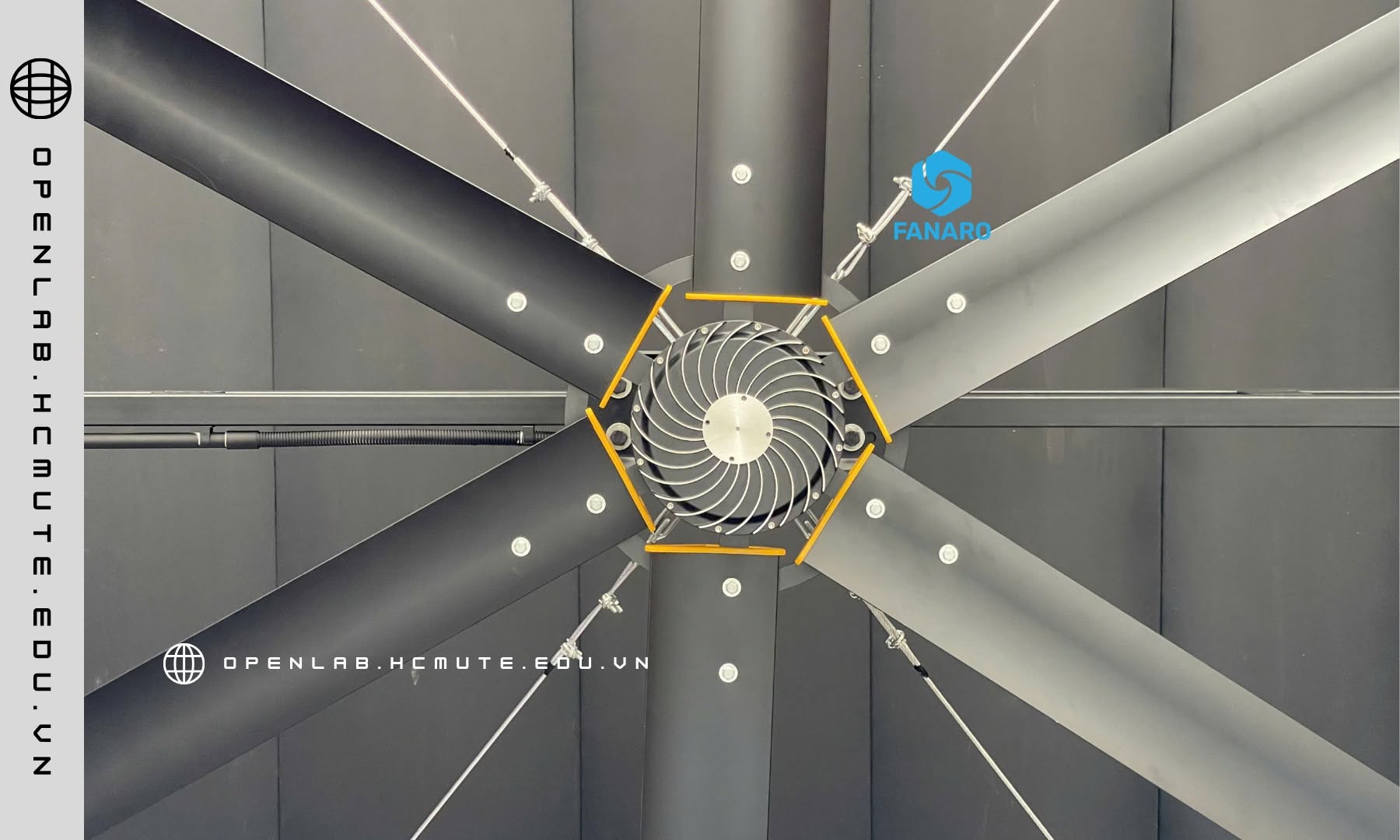
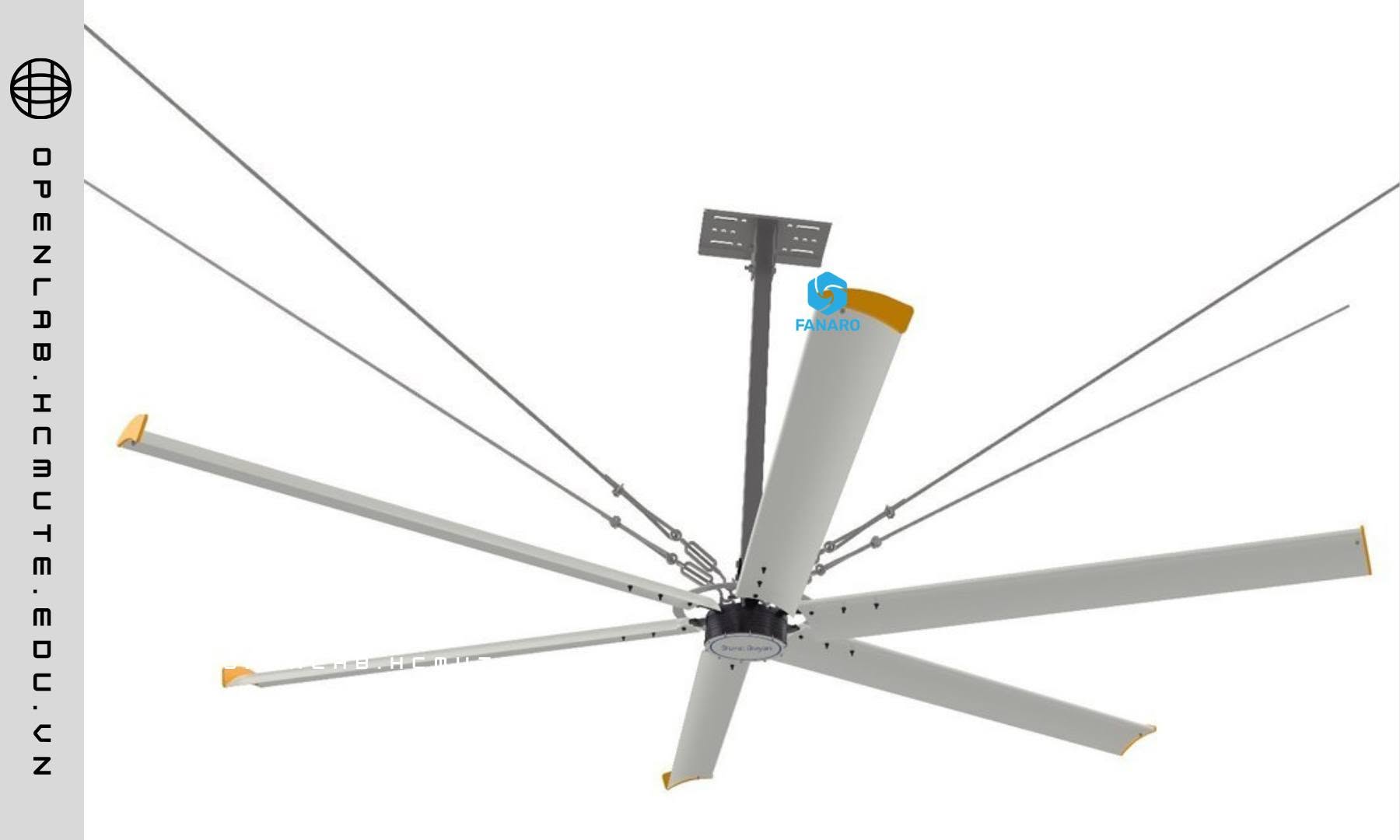
This is the core technical point explaining why PMSM is particularly well-suited to industrial HVLS ceiling fans. HVLS fans operate at very low rotational speeds (typically 30–60 RPM) while requiring sufficient torque to keep large-span blades (up to 7 meters) moving steadily.
Induction motors perform least efficiently precisely in the low-speed range — because the proportion of slip loss relative to total output power increases as speed decreases. PMSM, by contrast, maintains a relatively flat efficiency curve across the entire speed range, including at low speeds — since torque generation does not depend on slip. This is the core engineering reason (not merely a marketing figure) behind the 40–50% energy savings observed when comparing PMSM-driven HVLS fans to systems using multiple small industrial fans with induction motors.

4. Direct Drive — Eliminating Mechanical Intermediaries
Thanks to its ability to generate high torque even at low speed, PMSM enables direct-drive design — the motor shaft connects straight to the fan blades, with no gearbox or belt drive required, unlike many legacy industrial fan systems that use high-speed motors paired with mechanical speed reducers.
Eliminating this intermediary stage delivers three compounding technical benefits:
- Reduced mechanical losses: every intermediate transmission component (gears, belts) introduces friction losses that reduce overall system efficiency
- Fewer failure points: gearboxes and belts are components with limited service life, requiring periodic maintenance, lubrication, and replacement — this is precisely the hidden operating cost that many businesses overlook when comparing only the upfront purchase price
- Lower mechanical noise: with no gear meshing or belt friction noise, only aerodynamic noise from the airflow remains — this is why PMSM-driven fans achieve noise levels below 40dB, comparable to a quiet library

5. Thermal Characteristics and Motor Longevity
Because there is no slip loss in the rotor, PMSM generates significantly less heat than an induction motor under equivalent load conditions — lower operating temperature means the stator winding insulation, bearings, and associated electronics (driver, encoder) experience lower thermal stress throughout the product’s service life. Per the Arrhenius principle as applied in electrical engineering (roughly, every 10°C increase in operating temperature halves insulation life), maintaining a low operating temperature is a key factor enabling PMSM to achieve longer service life, with reduced maintenance and component replacement frequency.
6. The Role of the Driver/Controller
One technical point often overlooked: PMSM cannot run directly off AC line power the way induction motors can — it requires a dedicated electronic controller (typically a specialized inverter or an FOC – Field Oriented Control – drive) to generate current with the waveform and frequency precisely synchronized to rotor position (typically determined via Hall sensors or an encoder).
This is precisely what enables PMSM to deliver smooth, precise speed control across a wide range — the technical foundation that allows modern fan systems to incorporate remote control, scheduled speed programming, or integration with smart sensor systems (IoT, AI) for automatic speed adjustment based on real-world space conditions.

7. Technical Conclusion
Taken as a whole, PMSM’s advantage over conventional induction motors does not stem from any single improvement, but from the compounding effect of three factors: (1) eliminating slip loss thanks to a fixed rotor field, (2) maintaining consistently high efficiency across the low-speed range — precisely the operating condition of HVLS fans, and (3) enabling direct-drive design, which removes intermediate mechanical losses and failure points. This is why PMSM is increasingly becoming the new technology standard for equipment demanding high-efficiency, continuous, and durable operation over time — with industrial HVLS ceiling fans standing as one of the clearest applications of this technical advantage.
Bình luận